;;;e
The most fascinating thing about The Sorrow of Ending War is that it writes something profoundly heavy in an almost frivolous manner.
Red King will descend upon Earth in three hours, and the world has fallen into a panic of uncertainty. Such an opening should have led into a disaster narrative, a heroic narrative, or a solemn anti-war essay. Yet the author does not have the protagonist rush immediately to the battlefield, nor does he make him deliver a declaration about the fate of humankind. Instead, at the end of the world, the protagonist thinks of one tiny thing: eating a hamburger.
This stroke is absurd, but also strangely precise. When people face a catastrophe too vast to comprehend, they often find it difficult to truly understand the words “the end of the world.” Things that are too grand make people numb; fears that are too distant lose their shape. In that moment, a hamburger becomes more real than the entire Earth. It has the dryness of bread, the changing texture of its patty, the sea of people waiting in line, and the awkward hunger before a morning exam. The apocalypse is abstract, but the hamburger is concrete; Red King is far away, but the food cart outside the school gate is right in front of him.
Even more interestingly, the author writes the entire essay upside down, as if refusing, from the very first glance, to enter the normal order of composition. Whoever reads it must turn the screen, adjust their posture, and temporarily put aside the habit of thinking that “an essay should be read this way” before they can truly enter the text. This inversion is consistent with the worldview inside the essay. Since the world in the story is already absurd enough for Red King to descend, for a hamburger to become a possible instrument of ending war, and for humanity itself to be the one that shoots the protagonist dead, why must this exam paper still be written right side up? The inverted handwriting appears like an omen in advance: this is not a normal world, and this is not an essay willing to submit to a normal way of being read.
The essay therefore creates a strange contrast. It constantly uses grand words such as “universe,” “nothingness,” “salvation,” “destruction,” “destiny,” and “the all-knowing and all-powerful,” yet again and again, it brings everything back to the hamburger. The author seems deliberately to pull the sublime down and lift the lowly upward. The hamburger is no longer merely food. It nearly becomes a faith, an obsession, the last certainty one can grasp in the vastness of the universe.
The hamburger in the essay is not a hamburger in the culinary sense. It is “not large,” and “the bread was dry”; later, it even makes the protagonist “thirstier.” It is not perfect. It may even be somewhat bad. But precisely because of this, it feels more like memory in real life. Many things we miss are not necessarily good in themselves. What we miss is not how exquisite they were, but the fact that, at a certain moment, we once loved them seriously. That hamburger carries not taste, but time; not fullness, but a vague, clumsy, indescribable attachment from youth.
So when the essay writes, “perhaps it could no longer even be called the same ‘it,’” the emotion of the whole piece has already quietly emerged from beneath the joke. On the surface, it is saying that the hamburger has changed; in truth, it is saying that memory cannot be restored. Even if the sauce is the same, even if the bun is just as dry, it is no longer the original hamburger. Time has passed, the scene has changed, and the person has changed too. An ordinary school hamburger is written as an entrance back into the past, yet that entrance can no longer truly be opened.
In the latter half, Red King descends, war breaks out, and the essay suddenly enters a heroic narrative. But this heroic narrative is deliberately written askew. “I arrived, because I had to come.” The sentence carries a kind of adolescent solemnity, as if the boy imagines himself as the savior of the world. Yet immediately afterward, when he stands beneath Red King’s feet and realizes how weak he is, he adds, “although I have never been to America, I have watched videos.” This sentence is excellent. It instantly deflates the grand posture, and in doing so, makes the protagonist lovable. He is not a hero in the traditional sense. He is only an ordinary person carrying a hamburger, someone who has watched videos, someone whose legs would tremble.
And yet it is precisely this ordinary person who brings about the most moving moment of the entire piece.
Red King stops his advance not because of weapons, not because of negotiation, not because of the dignity of human civilization, but because he sees the hamburger in the protagonist’s hand. The scene is absurd to the extreme, yet within the essay’s internal logic, it gains a fairy-tale-like plausibility. Since the hamburger has already been written as a symbol of human desire and memory, Red King’s attraction to it is no longer merely a joke. It seems to say that perhaps what can truly stop war is not greater power, but something simple and shared: hunger, curiosity, appetite, or perhaps a small longing for the warmth of earthly life.
But the essay does not stop at this tender moment. At the end, it suddenly turns cruel: a bullet pierces through “my” chest, and the words reaching the protagonist’s ears before death accuse him of “betrayal.”
This gunshot makes all the earlier absurdity suddenly heavy. Red King does not kill “me”; humanity itself does. “I” may have been approaching peace in a ridiculous yet effective way. The monster has already stopped. Yet humanity, driven by its own fear and suspicion, ends everything first. At this moment, the “sorrow” in the title truly falls into place. It is not a sorrow brought by Red King, but a sorrow created by humankind itself.
“Hahahaha. So this is human nature? Red King, I am beginning to understand you.” This is the sharpest line in the entire essay. It pushes the protagonist’s dying consciousness into a state of absurd clarity. He is not understanding the monster’s power; he is understanding the monster’s position. What truly drives him to despair is not how dangerous the world is, but how quickly human beings, in fear, can turn one of their own into an enemy.
And the final line, “I want to eat a~~ hamburger~~ so badly……” brings everything back to the beginning. The world, war, human nature, betrayal, and death still cannot overpower that original thought: wanting to eat a hamburger. The ending has a lingering aftertaste. It is funny and sorrowful at once; it sounds like a joke, and also like a last word. A person, before death, does not shout a slogan or leave behind heroic words. He simply wants one more hamburger. Precisely because of this, he feels more alive than any hero.
The upside-down form gains deeper meaning here as well. It becomes the visual metaphor of the entire essay: the world has been overturned, order has been reversed, and good and evil, loyalty and betrayal, enemy and fellow human are no longer stable categories. The reader must turn the exam paper upside down to understand the words; the protagonist, before death, must also turn the positions of “humanity” and “monster” upside down before he finally understands Red King. The formal inversion ultimately corresponds to an inversion of value judgment.
The value of The Sorrow of Ending War lies precisely in its refusal to be proper. It uses improper language, improper plotting, improper jokes, and even an improper direction of writing to produce a very proper sadness. It turns the apocalypse into a school cafeteria, salvation into the act of handing over a hamburger, sacrifice into “betrayal,” and a final statement into appetite. The more absurd it becomes, the more absurd the world itself appears; the funnier it is, the colder that final gunshot feels.
This essay resembles a dark fable with a strong sense of youthfulness. It does not take responsibility for solemnity; instead, it strips solemnity of its polished surface and reveals the ridiculous and sorrowful things underneath. Red King, hamburgers, Victoria Harbour, the Statue of Liberty, exams, artillery fire, betrayal, and the entire upside-down exam paper—these elements should not belong together. Yet it is precisely this sense of “should not” that gives the piece its unique vitality.
After reading it, what remains most vividly in the mind is not Red King, nor the war, but that dry hamburger. It is not delicious, yet it becomes the last taste of earthly life before the apocalypse. It is laughable, yet it briefly makes the monster stop. It is tiny, yet it comes closer to life itself than all those grand words. And the upside-down handwriting is like the essay’s first silent declaration to the reader: in an absurd world, even an essay has no need to live right side up.
Source Text
The Sorrow of Ending War
Red King would descend upon Earth in three hours. Major media outlets around the world were scrambling to report the news, spreading it into a frenzy. Whether his arrival meant salvation or destruction, I had no way of knowing. Opinions were everywhere. I only wanted to eat a hamburger first.
The universe is silent, and human life is insignificant. I came from nothing, and naturally I shall return to nothingness. The only thing I still cared about, the one obsession I could not let go, was the hamburger at school. It was not large, and the bread was dry. I first encountered it three years ago. I was young; it was distant and dreamlike. I took a bite and said, “Wow.” It was delicious. But later, I kept arriving later and later for meals. To reunite with my former beloved, I had to face a sea of people. I waited again and again.
Alas, dreams have nowhere to return; I only regret that everything passed too quickly. At some point, the hamburger patty became homemade beef. Granted, it gained a touch of human warmth and lost some of its processed feeling, but the dry texture combined with the equally dry bun made me lose my former love for it. Perhaps it could no longer even be called the same “it.”
Recently, the food cart outside the school gate also started selling hamburgers. It used the same sauce, yet it was only the old thing again, with a bun just as dry as before. One morning before an exam, I was hungry and craving food, so I bought a hamburger. It only made me thirstier.
But the universe is vast and boundless. Who, after all, can rule over the school hamburger? In truth, everything in this world has its own destiny. I do not believe in Buddha; I believe in God. Perhaps the all-knowing and all-powerful Lord will scatter merciful hamburgers across the earth, whether while I live or after I die.
Red King descended, at Victoria Harbour.
There was no negotiation. Amid smoke and gunfire, amid the roar of artillery, the world fell into color.
I arrived, because I had to come. As a young person of the new era, shouldering the historical mission and the heavy responsibility of great national rejuvenation, who else but me could save the world?
But the moment I stood beneath Red King’s feet, I realized how weak I truly was. He was even taller than the Statue of Liberty, though I have never been to America. I have watched videos, though.
Red King stopped his advance. He lowered his head to look at me and motioned for me to give him my hand. I did not dare refuse, yet I could not stop trembling. So that was it. He wanted the hamburger in my hand. It seems that no matter how advanced a life-form may be, it still cannot resist the temptation of a hamburger.
A bullet pierced through my chest. In the moments before death, the words that reached my ears were saying that I had betrayed humanity. Hahahaha. So this is human nature? Red King, I am beginning to understand you. But suddenly… I want to eat a~~ hamburger~~ so badly……
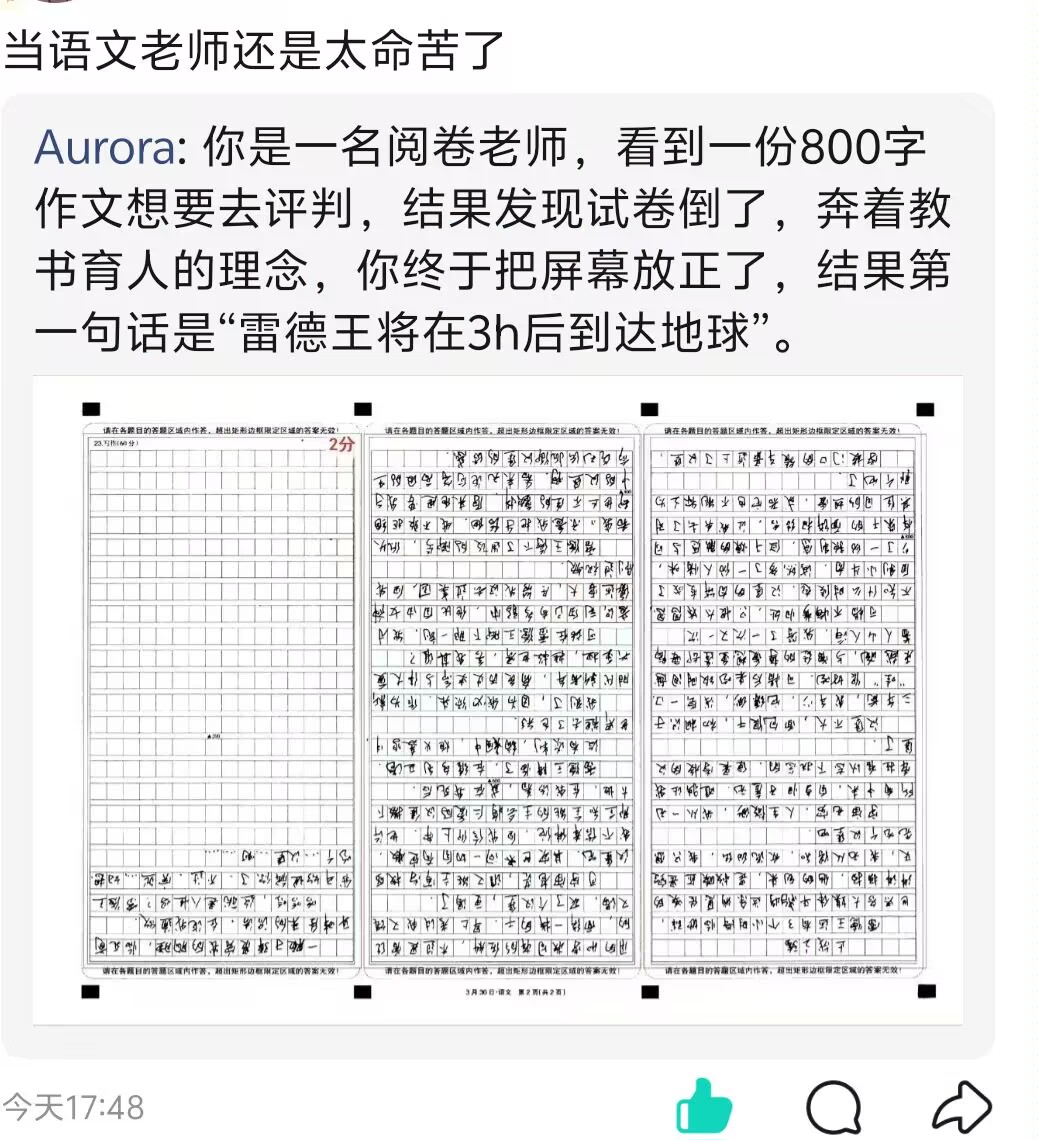
Aside|About That 2 Points
This essay later received only 2 points. The score itself feels like another layer of absurdity growing outside the text.
From the perspective of the examination system, the 2 points are not entirely incomprehensible. An exam essay is first of all an act of answering a question, and it assumes that the writer will obey a basic order. The characters should face the right way, the paper should be easy to read, the theme should be quickly recognizable, and the writing should reduce the burden on the grader as much as possible. The Sorrow of Ending War refuses this order from the very beginning. It turns the entire essay upside down, forcing the reader to rotate their view before entering the text. In an exam setting, this is almost an open refusal to cooperate. The extremely low score then becomes a natural reaction from within the system.
This is where the 2 points form a strange intertext with the essay itself.
In the essay, the protagonist walks toward Red King with a hamburger in his hand. Perhaps he is approaching peace in an absurd, ridiculous, almost unreasonable way. Red King has already stopped. For a brief moment, war seems to open a narrow crack. Yet humanity does not understand him, does not wait for him, and does not try to read the possibility hidden inside this absurd gesture. It simply judges him as a traitor. A bullet pierces through his chest.
The real-world score resembles that bullet. Through inverted handwriting, absurd plotting, and the image of the hamburger, the writer creates a textual order of his own. The grading system never enters that order. It first sees an answer sheet that is improper, uncooperative, and outside the norm, then completes its judgment with an extremely low score. In this sense, the 2 points become a real-world verdict of “betrayal.” The text clearly has its own logic and vitality, yet it is quickly pushed aside because it does not stand where the examination order expects it to stand.
This does not have to be turned into a simple case of injustice. The teacher is facing an exam, not a literary magazine. Their task is not to search for avant-garde meaning in every strange essay. By choosing to write upside down, the author has already accepted the risk of being misread, rejected, and punished. That very risk is what makes the score meaningful.
The Sorrow of Ending War writes about a person who is not understood by the normal order, and in the end, the essay itself truly encounters the cold gaze of that order. The protagonist dies under the accusation of “betrayal”; the essay dies because of its unruly page. The 2 points do not simply end the essay. They feel more like a final paragraph added outside the text. In a world that only allows reading right side up, writing upside down has already become its own crime.
;;;e;;;c
《止战之殇》最迷人的地方,在于它用一种近乎轻佻的方式,写出了非常沉重的东西。
雷德王还有三个小时降临地球,世界陷入未知的恐慌。这样的开头本应通向一篇灾难叙事、英雄叙事,或者一篇庄严的反战文章。可是作者没有让主人公立刻奔赴战场,也没有让他发表关于人类命运的宣言,而是让他在世界末日前想到了一件极小的事:吃一个汉堡。
这一笔很荒诞,也很准确。人在面对过于巨大的灾难时,反而很难真正理解“世界毁灭”这四个字。太宏大的事物会让人麻木,太遥远的恐惧会失去形状。于是,一个汉堡反而比整个地球更真实。它有面包的干涩,有肉饼的变化,有排队时的人山人海,有早上考试前又饿又馋的狼狈。世界末日是抽象的,汉堡却是具体的;雷德王是遥远的,学校门口的餐车却近在眼前。
更有意思的是,作者把整篇文章倒过来写,仿佛从第一眼开始,就拒绝进入正常作文的秩序。读它的人必须转动屏幕,调整姿势,甚至暂时放下“作文就应该这样看”的习惯,才能真正进入文本。这种倒置和文章内部的世界观是统一的。既然文中的世界已经荒诞到雷德王即将降临,汉堡可能成为止战之物,而真正开枪杀死主人公的却是人类自己,那么这张试卷为什么还必须正着写?倒过来的字迹像是一个提前出现的暗示:这不是一个正常的世界,也不是一篇愿意服从正常阅读方式的作文。
文章因此形成了一种奇妙的反差。它不断使用“宇宙”“虚无”“救赎”“毁灭”“定数”“全知全能”这样的宏大词汇,却又一次次把落点放回汉堡上。作者像是在故意把崇高的东西拉低,把低微的东西抬高。汉堡不再只是食物,它几乎变成了一种信仰,一种执念,一种人在宇宙苍茫中能够抓住的最后的确定性。
文中的汉堡并不是美食意义上的汉堡。它“不大,面包很干”,后来又让人“更渴了”。它并不完美,甚至有点难吃。但正因为如此,它才更像真实生活里的记忆。很多让人怀念的东西,本来就不一定真的好。我们怀念的不是它多么精致,而是当时的自己曾经认真地喜欢过它。那个汉堡承载的不是味觉,而是时间;不是饱腹,而是青春里某种模糊、笨拙、说不清楚的眷恋。
所以,当文章写到“或者它也不能称为那个它了”时,整篇的情绪其实已经从玩笑里悄悄露出来了。表面上是在说汉堡变了,实际上是在说记忆无法复原。即使佐料相同,面饼同样干,它也已经不是原来的那个汉堡。因为时间过去了,场景变了,人也变了。一个普通的学校汉堡,被写成了通往往日的入口,而这个入口已经无法真正打开。
后半部分,雷德王降临,战争爆发,文章突然进入英雄叙事。但这种英雄叙事又是被故意写歪的。“我到了,因为我必须来。”这一句有一种中二式的庄严,像是少年把自己想象成救世主。可紧接着,他站在雷德王脚下,意识到自己的弱小,又补上一句“尽管我没去过美国但我刷过视频”。这种句子非常好,它让宏大的姿态立刻漏气,却也因此显得可爱。主人公不是传统意义上的英雄,他只是一个带着汉堡、刷过视频、腿会发抖的普通人。
但正是这个普通人,带来了全文最动人的瞬间。
雷德王停下进攻的脚步,不是因为武器,不是因为谈判,不是因为人类文明的尊严,而是因为他看见了主人公手中的汉堡。这个情节荒唐到了极点,却又在文章内部获得了一种童话般的合理性。既然汉堡已经被写成了人间欲望和记忆的象征,那么雷德王被汉堡吸引,就不再只是一个笑话。它像是在说:也许真正能让战争停下来的,不是更强大的力量,而是某种最简单、最共同的东西——饥饿、好奇、食欲,或者说,对人间烟火的一点点向往。
可是文章没有停在这个温情的瞬间。它最后突然转向残酷:一颗子弹贯穿了“我”的胸膛,濒死前耳畔传来的话语,是“通敌”。
这一枪让前面的荒诞全部变得沉重起来。雷德王没有杀死“我”,杀死“我”的是人类自己。明明“我”可能正在以一种滑稽却有效的方式靠近和平,明明怪物已经停下脚步,人类却先一步用自己的恐惧和猜疑结束了一切。于是,文章题目里的“殇”真正落下来了。它不是雷德王带来的殇,而是人类自身造成的殇。
“哈哈哈,这就是人性吗?雷德王,我开始理解你了。”这句话是全文最锋利的地方。它把主人公临死前的意识,推向一种荒诞的清醒。他不是在理解怪物的力量,而是在理解怪物的立场。真正让他绝望的,不是世界有多危险,而是人在恐惧中会多么迅速地把同类变成敌人。
而最后一句“好想吃个~~汉堡~~啊……”又把一切拉回开头。世界、战争、人性、背叛、死亡,最后都没有压过那个最初的念头:想吃汉堡。这个结尾非常有味道。它既滑稽,又悲凉;既像玩笑,又像遗言。一个人临死前没有喊口号,没有留下豪言壮语,只是想再吃一个汉堡。也正因为如此,他显得比任何英雄都更像一个活生生的人。
倒过来写的形式,也在这里获得了更深的意味。它像是整篇文章的视觉隐喻:世界已经倒悬,秩序已经翻转,善恶、忠诚、背叛、敌人与同类都不再稳定。读者必须把试卷倒过来看,才能读懂文字;而主人公也必须在死亡前把“人类”和“怪物”的位置倒过来看,才终于理解了雷德王。形式上的倒置,最终对应着价值判断上的倒置。
《止战之殇》的可贵之处,就在于它的不端正。它用不端正的语言,不端正的情节,不端正的笑点,甚至不端正的书写方向,写出了一种很端正的悲哀。它把末日写成校园食堂,把救世写成递出汉堡,把牺牲写成“通敌”,把遗言写成食欲。它越是荒唐,越显得世界本身荒唐;它越是好笑,结尾那一枪就越冷。
这篇文章像一则少年气很重的黑色寓言。它不负责庄严,它负责让庄严失去表面的光泽,然后露出里面可笑又可悲的东西。雷德王、汉堡、维多利亚港、自由女神像、考试、炮火、通敌,以及整张倒过来的试卷,这些元素本来不该放在一起,但正是这种“不该”,构成了它独特的生命力。
读完之后,最让人记住的不是雷德王,也不是战争,而是那个干巴巴的汉堡。它不好吃,却成为了末日前最后的人间味;它很可笑,却短暂地让怪物停下脚步;它很微小,却比所有宏大的词语都更接近生命本身。而那倒过来的字迹,则像这篇文章留给读者的第一句无声宣言:在一个荒诞的世界里,连作文也没有必要正着活着。
原文
《止战之殇》
雷德王还有 3 个小时降临地球,世界各大媒体争相报道这条消息传唤的沸沸扬扬,他的到来,是救赎还是毁灭,我无从得知,众说纷纭,我只想先吃个汉堡吧。
宇宙无言,人生微渺。我从一无所有中来,自当归于虚无。唯独让我牵挂难以放下执念的,便是学校的汉堡了,汉堡不大,面包很干,初相识于三年前,我年少,它飘渺,浅尝一口:“哇”很好吃,可随后来吃饭的时间越来越晚,与曾经的挚爱重逢却要隔着着人山人海,我等了一次又一次。
可惜不薄梦归处,只恨太匆匆,不知什么时候起,汉堡的肉饼变成了自制小牛肉,陈然多了一份人情味,少了一份预制感,但干燥的触感与同样燥干的面饼相结合,让我失去了对其往日的热爱,或者它也不能称为那个它了。
学校门口的餐车最近上了汉堡,用的却是同样的佐料,不过是曾经的,面饼一样的干,早上考试我又饿又馋,买了个汉堡,更渴了。
可宇宙苍茫,谁又能主宰学校的汉堡呢?其实世间一切自有定数,我不信奉佛陀,自我信仰上帝,也许那全知全能的主会将仁慈的汉堡撒下大地。在我活着,或在我死后。
雷德王降临了,在维多利亚港。
没有谈判,硝烟中,炮火轰鸣中,世界陷入了色彩。
我到了,因为我必须来。作为新时代新青年,肩负历史使命与伟大复兴重担,拯救世界,舍我其谁?
可站在雷德王脚下那一刻,我才意识到自己有多弱小。他比自由女神像还要大,尽管我没去过美国但我刷过视频。
雷德王停了进攻的脚步,低头看我,示意我把手给他。等不敢拒绝却也止不住地颤抖,原来他是要我手中的汉堡啊,看来无论何等高级的生命,都无法抵御汉堡的诱惑。
一颗子弹贯穿了我的胸膛,濒死前耳畔传来的话语,在说我通敌。哈哈哈,这就是人性吗?雷德王,我开始理解你了。不过,突然……好想吃个~~汉堡~~啊……
题外话|关于那个 2 分
这篇文章后来只得了 2 分。这个分数本身,像是文本之外又长出来的一层荒诞。
从考试制度的角度看,2 分并非完全不可理解。作文首先是一种答题行为,它默认作者要服从某种基本秩序。字要正着写,卷面要便于阅读,主题要能被迅速辨认,表达要尽量减少阅卷成本。《止战之殇》偏偏从形式上就拒绝了这一点。它把整篇文章倒过来写,让读者必须先转动视角,才能进入文本。对于一场考试来说,这几乎是一种明目张胆的不配合。阅卷老师给出极低分,也就成了制度内部十分自然的反应。
也正是在这里,这个 2 分和文章本身形成了奇妙的互文。
文章里,主人公手持汉堡走向雷德王。他也许正在用一种荒唐、滑稽、近乎不可理喻的方式靠近和平。雷德王已经停下脚步,战争似乎出现了一瞬间的缝隙。可是人类没有理解他,没有等待他,也没有试图读懂这个荒诞行为背后的可能性,直接把他判定为“通敌”。一颗子弹贯穿了他的胸膛。
现实中的评分也像这一枪。作者用倒置的书写、荒诞的情节和汉堡的意象建立了一套自己的文本秩序,阅卷系统却没有进入这个秩序。它先看到的是不端正、不配合、不符合规范的答卷,然后用一个极低的分数完成了裁决。于是,2 分就像现实版的“通敌”判决。文本内部明明有自己的逻辑和生命,最后却因为没有站在考试秩序要求的位置上,被迅速排除出去。
这并不需要被写成一场简单的冤案。老师面对的是考试,不是文学杂志;他的任务也不是为每一篇怪异的作文寻找先锋意义。作者选择倒着写,本身就已经承担了被误读、被拒绝、被惩罚的风险。可也正是这种风险,让这个分数变得意味深长。
《止战之殇》写了一个不被正常秩序理解的人,而它自己最终也真的遭遇了正常秩序的冷眼。主人公死于“通敌”的指控,文章死于“离经叛道”的卷面。那个 2 分没有简单地结束这篇文章,倒像是在文章之外补上了最后一段。在一个只允许正着阅读的世界里,倒过来写本身就成了罪名。
;;;c